Planning a Walt Disney World trip is genuinely a bigger logistical project than most vacations. But it doesn't have to be the second job it's become for a lot of families. This guide breaks it into clear decisions, in the right order, without the noise.
Start with the honest conversation about dates
Everything downstream from your dates — hotel availability, crowd levels, Lightning Lane strategy, cost — flows from when you go. Have this conversation clearly before you touch any booking system.
Walt Disney World's busiest periods are predictable: the week of Thanksgiving, the two weeks around Christmas and New Year's, Presidents' Week in February, spring break weeks in March and April, and the bulk of June, July, and early August. During these periods, every park is more crowded, wait times are longer across the board, and hotel prices are significantly higher.
The resort's quietest periods are mid-January through early February (after the holiday crowd disappears), the weeks between Labor Day and Thanksgiving (excluding Columbus Day weekend), and early December before the holiday rush builds. September in particular is a well-kept secret among experienced Disney visitors — school has started in most states, the summer crowds have evaporated, and the park runs at a noticeably different pace.
If you have any flexibility in your travel window, comparing two or three candidate date ranges on a reliable crowd calendar (TouringPlans and UndercoverTourist both publish crowd data by date) is 30 minutes well spent.
Decide how many days you need at each park
Walt Disney World has four theme parks, each requiring a full day to experience meaningfully. That's the baseline.
If you're visiting for the first time, plan for at least four park days — one per park. This gives you enough time to cover the must-do attractions at each without feeling like you're sprinting. If your trip is shorter than four days, you'll be making real choices about what to skip, and it's better to know that going in than to discover it while standing at Animal Kingdom at 3 PM realizing you only have two hours left.
If you have young children with shorter stamina, add a day rather than trying to compress four parks into fewer days. A five-day trip with one shorter, relaxed park day built in is more sustainable than four jam-packed days that end in exhausted meltdowns.
Experienced guests often skip a park or repeat favorites on return trips — but for a first visit, four days and four parks is the framework that lets you actually see what Walt Disney World is.
Book your hotel first
Hotel availability at Walt Disney World — particularly at on-site Disney Resort hotels — becomes limited months in advance for popular dates. Before you think about anything else, choose where you're staying and book it.
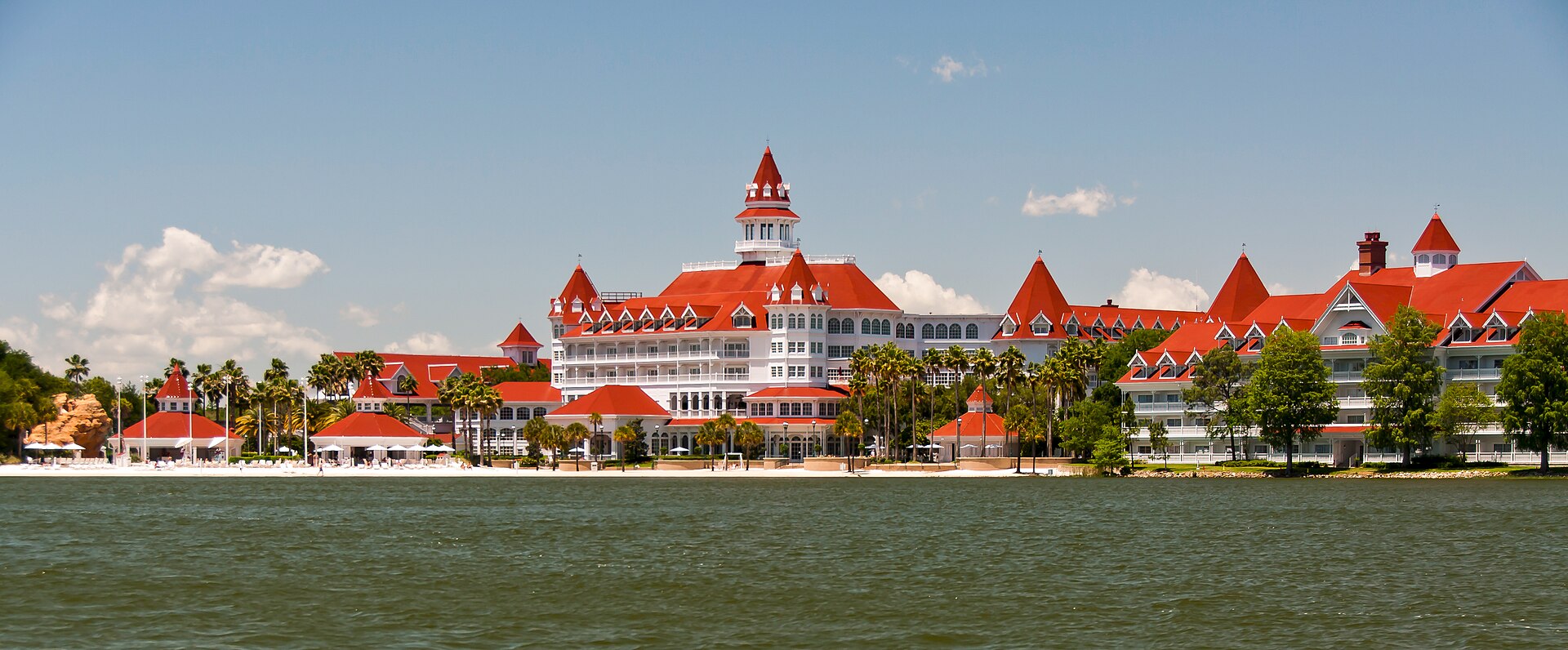
Photo by Sixflashphoto / CC BY-SA 4.0
The on-site vs. off-site question involves real tradeoffs. Staying at a Disney Resort hotel gives you free internal transportation between hotels and parks, Early Entry access (30 minutes before the general public at each park, every day), the ability to book Lightning Lane advance selections seven days before your visit (vs. three days for off-site guests), and the immersive experience of being inside the Disney resort ecosystem. On-site hotels range from value resorts to deluxe resorts, with prices varying accordingly.
Staying off-site — in one of the many hotels near the Disney property — is typically significantly less expensive per night and often means more space and amenities for families. The tradeoff is losing Early Entry, a later Lightning Lane booking window, and the need for a car or rideshare to get to the parks.
For families who are serious about maximizing park time and using Early Entry as a strategic advantage — particularly at Magic Kingdom where the 30-minute window on Mine Train or TRON has real value — on-site makes the cost difference easier to justify. For families where budget is a primary constraint, off-site with a disciplined rope drop strategy is a completely viable approach.
Understand the cost picture before you go
Walt Disney World is expensive, and the full cost often catches families off guard because it accumulates in layers.
Park tickets for adults currently start over $100 per day for regular tickets and rise significantly for peak dates and Park Hopper options. A family of four with four single-park days crosses $1,500 in tickets alone on a typical moderate-season visit.
Lightning Lane Multi Pass runs $15 to $39 per person per day depending on date and park. For a family of four visiting four parks with Multi Pass on each day, that's $240 to $625 in add-ons. Lightning Lane Single Pass for must-do attractions like TRON or Flight of Passage is an additional $10 to $30 per person per attraction.
Dining inside the parks is priced at a meaningful premium. A table-service dinner for a family of four typically runs $150 to $300 with drinks. Quick-service is more reasonable but still adds up across a multi-day visit.
Standard theme park parking is $35 per day at the theme park lots.
Building a realistic budget before you go — including all of these categories — prevents the financial stress of the trip bleeding into the experience itself. Walt Disney World is worth the cost for the families who choose it with eyes open; it's harder to enjoy when the spend feels out of control.
Make dining reservations as soon as your window opens — 60 days before arrival for resort guests (who can book their full stay), or 60 days before each individual date for off-site guests
Disney Resort hotel guests can book dining for their full stay — up to 10 nights — starting 60 days before arrival. All other guests can book dining reservations 60 days in advance for individual dates. The most popular restaurants fill within hours — sometimes within minutes — of opening that reservation window.
Set a calendar reminder for 60 days before your first park day and open the My Disney Experience app or website at 6 AM Eastern on that morning. Have your priorities decided in advance so you're not making choices on the fly while availability is disappearing.
The restaurants that warrant the most urgency: Topolino's Terrace at the Riviera (breakfast with characters, views over the resort), Be Our Guest at Magic Kingdom (dinner is the priority), Space 220 at EPCOT (the simulated space station setting is unlike anything else on the resort), and California Grill atop the Contemporary (especially worth booking on a fireworks night — you can watch from the observation deck).
Quick-service dining doesn't require reservations but does benefit from mobile ordering through the My Disney Experience app. Mobile order at quick-service locations and skip the counter line — it's consistently 15 to 30 minutes faster on a busy day.
Plan your Lightning Lane strategy before you arrive
The Lightning Lane system at Walt Disney World changed meaningfully in 2026, and understanding it before you arrive saves significant confusion inside the park.
The key change: guests can now book up to three Lightning Lane Multi Pass selections in advance. On-site hotel guests can do this seven days before their visit; off-site guests can book three days before. These advance slots go fast for high-demand attractions, particularly at Magic Kingdom. Knowing which three you want to book — and having your My Disney Experience app ready the morning your window opens — is worth the 10 minutes of advance thinking.
For a full breakdown of how the system works, which options to choose, and how to use Multi Pass effectively throughout the day, read our Walt Disney World Lightning Lane guide.
Build your park days around your top priorities, not a generic order
Every Walt Disney World planning guide suggests a "best order" for visiting the parks. The honest answer is that the right order depends on your group's priorities, the crowd levels on your specific dates, and whether you have Early Entry.
What matters more than order is making sure each park day has a clear top priority — the ride or experience that, if you missed it, would make the day feel incomplete — and building your morning around getting that done before the crowds build.
Identify your top priority for each park before you leave home:
At Magic Kingdom, it's probably either TRON Lightcycle / Run (newer, bigger crowds) or Seven Dwarfs Mine Train (relentless demand, never enough capacity).
At EPCOT, it's almost certainly Guardians of the Galaxy: Cosmic Rewind. Cosmic Rewind has a standby line and is Early Entry eligible; Lightning Lane Single Pass is an optional paid add-on, not the only access.
At Hollywood Studios, Rise of the Resistance is the clear top priority for most groups. It's the most technically ambitious attraction in the park and consistently draws the most demand.
At Animal Kingdom, Avatar Flight of Passage in Pandora is the headline. Nothing else at the park builds quite the same wait.
Structure your arrival time and first moves around those priorities. Everything else fills in naturally.
Know what the My Disney Experience app does before you arrive
The My Disney Experience app is your operating system for the trip. It handles park tickets, Lightning Lane reservations, mobile food ordering, wait times, show schedules, character locations, resort transportation times, and navigation. It is genuinely dense with features and not entirely intuitive for first-time users.
Spend 30 minutes with the app before your trip — not to plan everything, but to understand where things are. Know how to check live wait times, where to find the Lightning Lane booking interface, and how mobile ordering works. Doing that at home costs you half an hour. Figuring it out while standing in the park costs you the same time plus the stress of being in a crowd.
Build margin into every day
The biggest mistake in Walt Disney World planning is building a schedule with no room to breathe. You plan to be at the gate at 8:30 AM, ride four things before noon, have lunch at 12:30, do three more attractions in the afternoon, catch the parade at 3, ride two more things, watch the fireworks, and be back at the hotel by 10. That's not a vacation — that's logistics.
The days that feel most magical are the ones where your group has time to wander Main Street without a purpose, to stay at an attraction a second time because everyone loved it, to find a bench and eat a Dole Whip and just be somewhere extraordinary together.
Build that into your planning from the beginning. Pick your top three priorities per day and protect time for everything else to happen naturally. Disney is more than its ride count.
> The Co-Pilot Take: Write down three things per park day that would make the day feel complete. Not 15 things — three. Structure your morning around getting those done, then let the rest of the day happen. You will almost certainly exceed your list. And if you don't, you'll have done the three things that actually mattered.
Frequently asked questions

More magic.
Get the Theme Park Co-Pilot app and see real Walt Disney World wait times, crowd forecasts, and personalized plans.
Try free for 7 days →